
Mural Collection · Myths & Legends
The Cowherd and the Weaver Girl
Niúláng Zhīnǚ · The Cowherd and the Weaver Girl
Basis · Directly based on source material
Theme · Bonds of Love
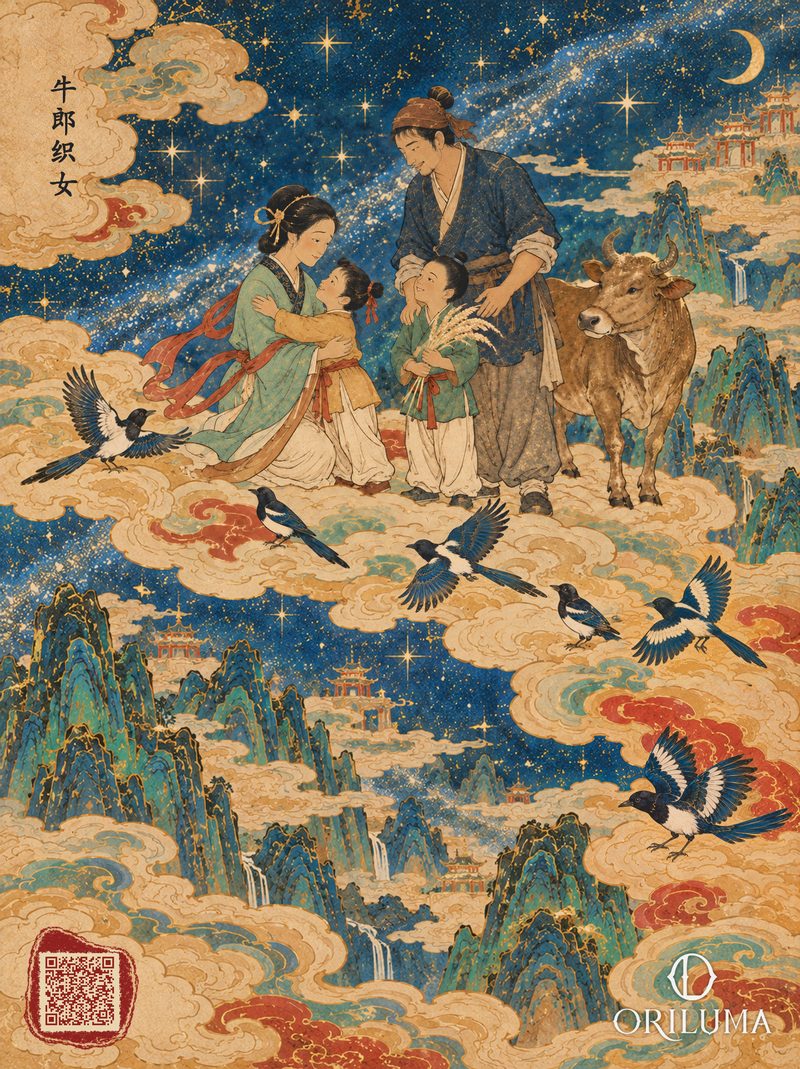
What the picture shows
The Milky Way parts the Cowherd and the Weaver Girl but cannot stop their longing; the magpie bridge, once every year, gives their parting a date for meeting again.
A blue river strewn with starlight cuts diagonally across the night sky, and a family stands among golden clouds above it. A path of cloud runs from their feet towards the lower right, and black-and-white magpies fly or settle along it, as if gathering to form that bridge.
On the left, the Weaver Girl kneels on the cloud, arms open, drawing a child into her embrace. On the right, the Cowherd, a cloth tied round his head and his sleeves rolled up, rests a hand on another child’s shoulder. That child holds a bunch of rice ears and looks up laughing, and the old ox stands quietly behind them. The rice and the old ox bring the farming days of the human world up into the sky as well.
In the upper right are a golden crescent moon and pavilions among the clouds; below are blue-green mountains and a waterfall. The coolness of the starry river and the warmth of the golden clouds share one picture. They are not gazing at each other across the river; they are already together. This is a reunion that really takes place, only a short one.
It should be said that in the more widely told versions the old ox is no longer alive at this point, and it is wearing the hide it left behind that the Cowherd pursues his wife into the sky. The painter has the ox stand on the cloud of the reunion too, bringing this old companion back to the family; this is not part of the original story.
The story
The Cowherd and the Weaver Girl
The Cowherd was a poor young man whose only companion was an old ox. According to legend, the Weaver Girl came down to the human world and met him; the two married, he farmed and she wove, they had children, and they lived a peaceful life.
The heavenly court discovered that the Weaver Girl had stayed in the human world without permission, and took her back. The Cowherd put on the hide the old ox had left him and set off after her, carrying the children on a shoulder pole. Just as he was about to catch up, the Queen Mother of the West drew a line with her hairpin and made the Milky Way, leaving husband and wife on opposite banks.
Their true love moved the magpies. Every year, on the seventh day of the seventh lunar month, flocks of magpies form a bridge so that the two can meet. After the brief reunion they must part again, so the Qixi festival holds both joy and sorrow.
The picture shows the moment the family is reunited on the clouds: the Weaver Girl, kneeling, draws a child into her arms; the Cowherd stands beside her, a hand on the other child, who holds the rice ears; the old ox keeps watch behind them; and the magpies line up one by one from beneath their feet along the cloud path into the distance. The distance has been closed, but only for this one night each year.
History and context
Origins and culture
The Weaver Girl star and the Cowherd star face each other across the Milky Way, and their names already appear in the Shijing (Book of Songs). Both stars are still easy to find today. The Weaver Girl star is Vega, the brightest star in Lyra; the Cowherd star is Altair, the brightest star in Aquila; together with Deneb in Cygnus they form the “Summer Triangle”. Look up on a summer night and the Milky Way runs right between the two. Altair also has a small star on each side, which folk tradition says are the Cowherd’s two children, carried on his shoulder pole. The idea of meeting on a magpie bridge spread very early. The Tang-dynasty encyclopedia Suihua Jili quotes a lost passage of the Fengsu Tong: “On the seventh night the Weaver Girl is to cross the river, and has the magpies make a bridge.” This passage, however, is not found in the Fengsu Tong as it survives today, and its original source is still disputed. The “Poem on the Seventh Night” by Yu Jianwu of the Liang dynasty in the Southern Dynasties already has the lines “I would ask the magpies of Diaoling: until the river is filled, you may not fly away.” The full plot, with the couple kept apart and meeting on the seventh night, went on developing after the Han and Wei, absorbing oral legends from many regions.
The old Qixi customs did not belong to lovers alone. Women would thread needles to beg for skill and set out melons and fruit, praying to the Weaver Girl for skill at weaving and for nimble hands, which tied a love story among the stars closely to real work.
Different regions tell of the old ox, the children, the Queen Mother and the magpie bridge in many ways. The story has lasted so long precisely because every age can see in it love across distance, families torn apart, and the hope of meeting again.
The two stars in the work will never truly come together, yet they are bound by gazing at each other from afar. The work lets us believe that distance can limit the time spent together, but cannot wholly cancel memory, promises and the wish to meet again.
The Shijing poem “Da Dong”, among the “Minor Odes”, already has the lines “In heaven there is the River Han, shining as it looks down; slanting there is the Weaver, moving seven times through the day”, which describe the River of Heaven and the Weaver Girl star. The Eastern Han line from the Nineteen Old Poems, “Far, far away, the Cowherd star; bright, bright, the maiden of the River Han”, comes closer to the later love story. Taken together, they show that the Cowherd and the Weaver Girl took a very long time to change from stars into a human story.
Threading needles on Qixi is said to go back to the Han palace. The Xijing Zaji (traditionally attributed to Liu Xin of the Western Han, though some say it was compiled by Ge Hong of the Eastern Jin; scholars differ on when it was written) records that Han palace ladies often threaded seven-eyed needles in the Kaijin Tower on the seventh day of the seventh lunar month. The Jingchu Suishi Ji by Zong Lin of the Liang dynasty in the Southern Dynasties gives a fuller account: on that night women tied coloured threads, threaded seven-eyed needles and set out melons and fruit in the courtyard “to beg for skill”. Later Qixi gained many more customs: airing books, airing clothes, worshipping the Weaver Girl, and dropping a needle onto water to test one’s skill.
Further reading
Sources and references
- Shijing (Book of Songs), Minor Odes, “Da Dong”pre-Qin
- Nineteen Old Poems, “Far, Far Away, the Cowherd Star”Eastern Han
- Xijing Zaji (Miscellaneous Records of the Western Capital)Eastern Jin; traditionally attributed to Liu Xin
- Jingchu Suishi Ji (Seasonal Customs of Jing and Chu)Zong Lin · Liang dynasty, Southern Dynasties
More in this set