
Mural Collection · Myths & Legends
Li Ji Slays the Serpent
Lǐ Jì Zhǎn Shé · Li Ji Slays the Serpent
Basis · Directly based on source material
Theme · Wit and Courage of Women
What the picture shows
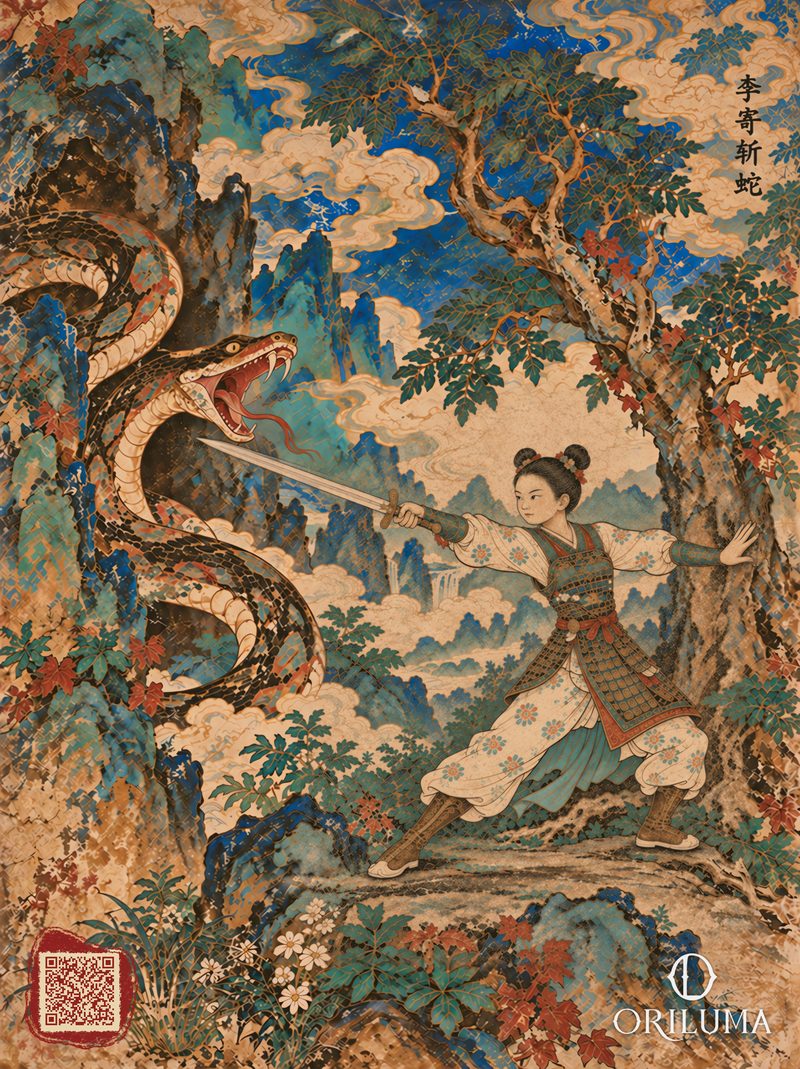
The girl Li Ji volunteers to go into the serpent’s lair and, with wit and courage, kills the giant serpent that had long devoured young girls, ending a whole region’s fear.
In the lower middle of the picture, a slight young girl lunges forward, one hand holding a sword straight out in front of her, the other arm stretched back to keep her balance. Her hair is done in two small buns on top of her head; she wears a wide-sleeved white tunic with a flower pattern and long trousers, a short vest like plated armour over them, and boots: a neat, practical outfit.
On the left is a huge, thick serpent, its body coiled among the mountain rocks, its head raised high, its open mouth showing a red tongue and sharp fangs. On the right stands an old tree with dense foliage; in the distance, mountain peaks and a waterfall appear through clouds and mist.
The gap left between the two is the tensest place in the whole picture: sword point faces serpent head, and whoever moves first wins. The painter has turned a girl’s courage into a calm, precise standoff, and keeps only this one moment of girl and serpent facing each other.
The story
Li Ji Slays the Serpent
The Soushen Ji (In Search of the Supernatural) says that on Yong Ridge in the Min region there lived a giant serpent that often brought disaster. Following the words of shamans and diviners, the local people offered it a girl of twelve or thirteen in the eighth month of every year; nine girls had already died this way.
Li Dan of Jiangle County had six daughters and no son. Li Ji was the youngest, and the family was poor. She asked of her own accord to answer the call, hoping to help her parents with the money and grain it brought; her parents could not bear to agree, but she still found a way to go.
Li Ji took a sharp sword and a dog that could bite snakes, and she set out rice cakes and honey at the mouth of the cave. Drawn by the smell, the giant serpent came out to eat; she first set the dog on it, then struck with her sword from behind, and at last killed the serpent.
She went into the cave and saw the bones left by the girls who had died before her, and lamented that they had been devoured because they were timid. In the picture she faces the serpent head-on, but what truly matters is the careful preparation beforehand, not inborn strength alone.
History and context
Origins and culture
The story comes from chapter 19 of the Soushen Ji by Gan Bao of the Eastern Jin. It has the colour of a tale of the strange, yet it is unlike stories in which people wait for gods or immortals to rescue them: the one who ends the disaster is the very young woman who had been chosen as the sacrifice.
Li Ji uses food to lure the serpent, a hunting dog to hold it off and a sword to attack, which shows observation and strategy. She reverses the passive place the ritual assigned her: going into the serpent’s lair is not accepting her fate but choosing the battleground herself.
Later tradition often places her alongside other heroines who slew monsters. The story also criticises a community that for years bought temporary peace with the lives of the weak: what truly had to end was not only the serpent but also the order of fear that took the sacrifice of girls for granted.
Li Ji is rewarded in the end, but the most powerful moment of the work comes before the victory. The person most easily sacrificed decides to stop waiting, and with her own plan ends a cycle that everyone had thought could never change.
The Soushen Ji is a collection of tales of the strange compiled by Gan Bao of the Eastern Jin, and many of its stories draw on folk hearsay. The story ends by saying that when the King of Yue heard of Li Ji’s deed, he took her as his queen and appointed her father magistrate of Jiangle.
Li Ji’s story is included in chapter 19 of the Soushen Ji. The most unusual thing about it is that she prepared beforehand: she brought a hunting dog that bit snakes and used rice cakes and honey to lure the serpent out of its cave. Unlike stories in which monsters are subdued by divine power, it is more like a planned operation, one that lets an ordinary person defeat a monster of legend.
Further reading
Sources and references
- Soushen Ji (In Search of the Supernatural), chapter 19Gan Bao · Eastern Jin
More in this set