
Mural Collection · Myths & Legends
Chang'e Flies to the Moon
Cháng'é Bēn Yuè · Chang'e Flies to the Moon
Basis · Directly based on source material
Theme · Chinese Myths
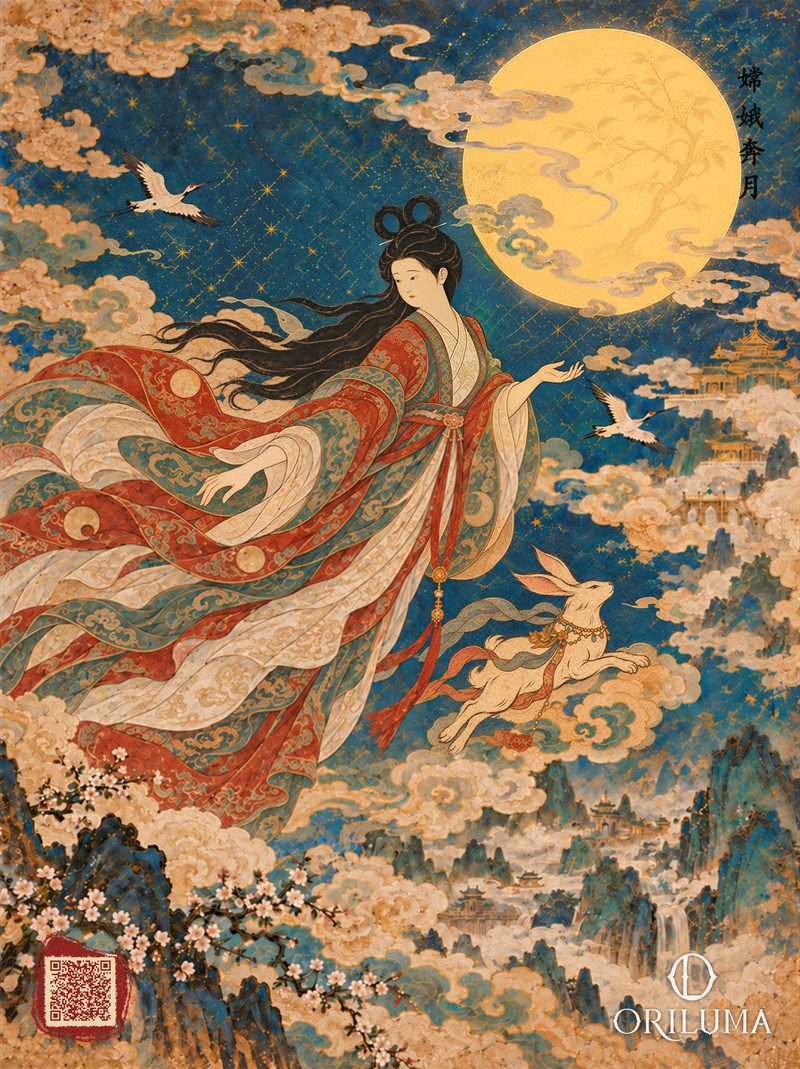
What the picture shows
A long journey from the human world to the moon palace, and a story Chinese people have told again and again while gazing at the moon.
A golden full moon hangs at the upper right. Chang’e flies upward on a slant, one hand reaching towards the moon with the palm turned up, the other opening downwards; she turns her head and looks back down at the human world. Her long hair and wide sleeves sweep back in long curves. The moon is not a distant backdrop: it is where she is going, yet she still looks back at what lies behind her.
Below her a white rabbit leaps in the same direction, and two white cranes fly with her through the clouds. The rabbit is the moon palace’s most constant resident; the crane, in the old imagination, was a spirit bird that travelled to and from the heavens. With them, the ascent does not feel lonely.
At the bottom of the picture are branches in white blossom; palace roofs show between the clouds, and a waterfall falls at the lower right. The things of the human world are left behind, and the higher one looks, the thinner and brighter the colours become. Red, blue-green and gold alternate along her sashes, keeping a little warmth in the deep blue of the night sky.
The story
Chang'e Flies to the Moon
Long ago, ten suns appeared in the sky at once. They scorched the earth, the rivers dried up and the crops withered. The divine archer Hou Yi climbed to a high place and shot down nine of the suns, leaving only one to shine on the human world. The people could live again, and he became a hero they honoured.
According to legend, the Queen Mother of the West gave Hou Yi a packet of the elixir of immortality. One day, in a moment of danger, Chang’e swallowed it. As the elixir took effect her body grew lighter, her feet left the ground, her sashes opened in the night wind, and she rose higher and higher into the sky.
Chang’e could not bear to leave the human world, nor Hou Yi, so she chose the moon, the place closest to the earth, as her home. Later legends add that Hou Yi gazed at the moon longing for her and set out offerings in his courtyard in her memory. These episodes gradually became linked with customs such as admiring the moon and making offerings to it, but they are not a complete story already found in the early texts.
In later imagination the moon palace slowly gained the Jade Rabbit, the osmanthus tree and Wu Gang, yet Chang’e has always remained its loneliest and brightest figure. She gained eternity but was cut off from the human world; she flew towards freedom and bore a parting too. The work captures the very moment when her sashes meet the wind and she looks back towards the land she is leaving.
History and context
Origins and culture
The myth did not have the full plot we know today from the start. What the early texts left is very short: the Huainanzi says only that Yi obtained the elixir of immortality from the Queen Mother of the West, and that “Heng’e [Chang’e] stole it and fled to the moon”. Details such as the ten suns rising together, Feng Meng trying to seize the elixir, and offerings set out beneath the moon came from retellings over many centuries, merging and filling in the story.
Different versions also give Chang’e different choices. Some make her the one who secretly took the elixir; others say she swallowed it so that it would not fall into the hands of a villain. The first telling carries a warning about desire and immortality; the second puts more weight on sacrifice and protection. Both leave her inside a decision from which there is no return.
Looking up at the shadows on the moon’s face, people of old imagined a toad, the Jade Rabbit and the osmanthus tree as its residents. As poetry, painting and festival customs spread, Chang’e slowly changed from a figure in a spare myth into the central character of the moon palace world. The cold moonlight thus became more than a sight in the sky: it became a symbol of parting, remembrance and distance.
The ascent in the picture is not an easy flight. Her sashes pull downwards while the elixir carries her body upwards, so the movement holds both breaking free and reluctance to leave. The viewer knows she will reach the moon palace where no one grows old, and knows too that there is no hearth smoke of the human world there. This coexistence of gain and loss is why the story is still retold after so many centuries.
A rabbit in the moon was already a common image in the Han dynasty. On the T-shaped silk painting excavated from Han Tomb No. 1 at Mawangdui in Changsha, a toad and a jade rabbit are painted on a crescent moon; the writings of Fu Xuan of the Western Jin also mention a white rabbit in the moon pounding medicine. Only later did “the Jade Rabbit pounding medicine” and “Chang’e flying to the moon” come together into the picture of the moon palace we know today.
The Tang poet Li Shangyin wrote: “Chang’e must regret stealing the elixir: blue sea, blue sky, her heart night after night.” He read the story as the price of immortality: to gain a long life is also to gain a long loneliness. This reading had a deep influence, and in the poems that followed, the moon often speaks for people of longing and regret.
Today “Chang’e” is also the name of China’s lunar exploration programme. Chang’e 1 was launched in 2007, and in 2019 Chang’e 4 made a soft landing on the far side of the Moon. A myth already recorded in texts more than two thousand years ago shares its name with present-day probes, a sign that people’s curiosity about the moon has never ceased.
Further reading
Sources and references
- Huainanzi, “Peering into the Obscure” (Lanming Xun)Western Han
- Lingxian (The Spiritual Constitution of the Universe)Zhang Heng · Eastern Han
- “Chang’e”Li Shangyin · Tang
More in this set