
Mural Collection · Of This World
Flying a Kite
Fàng Fēngzheng · Flying a Kite
Basis · Cultural background
Theme · Everyday Life
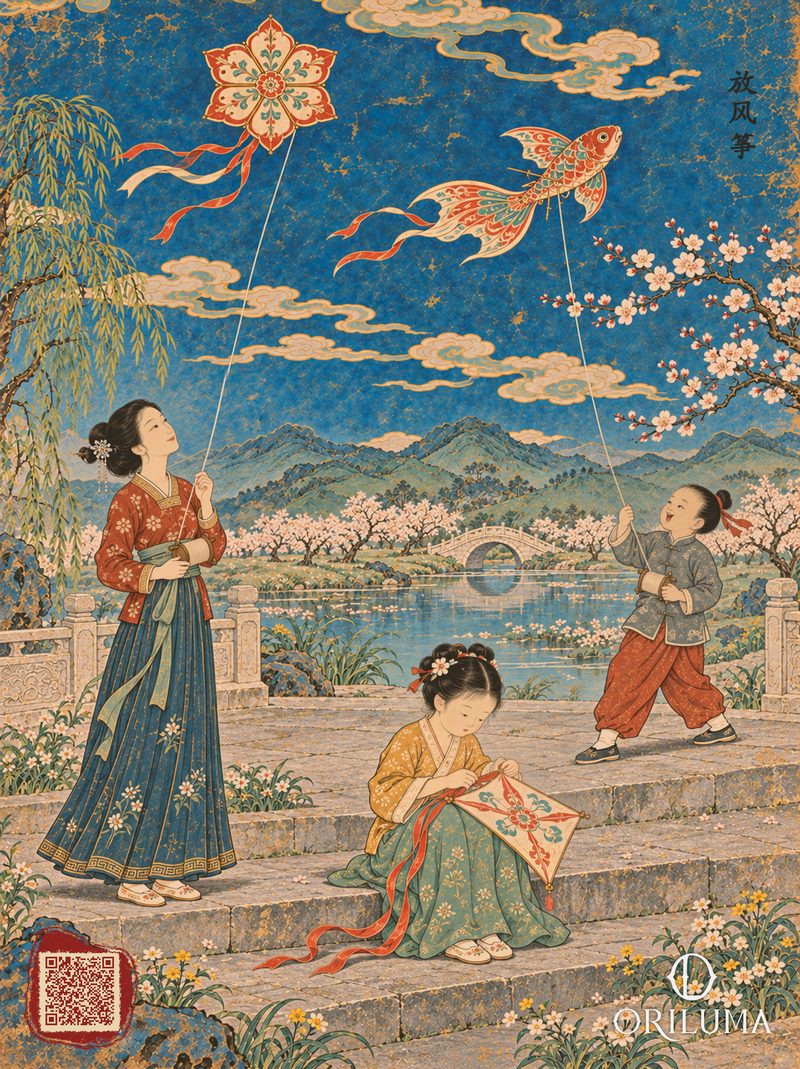
What the picture shows
The string in the hand, the kite below the clouds: a spring wind turns an everyday game into a wish sent up to the sky.
On the left of the picture a woman in a red top and blue skirt stands on stone steps, one hand pinching the string, the other holding up the reel, her face turned to the sky with a smile. On the right a child in a grey-blue jacket and orange-red trousers also grips a reel and strides forward, laughing and looking up at the sky.
Two kites fly in the sky: one shaped like a six-petalled flower, the other like a goldfish, both trailing long red tails, and their two strings run down to the woman’s and the child’s hands. In the middle of the steps sits a little girl in a yellow top and green skirt, head bowed, straightening the red streamers of a diamond-shaped kite on her knees; this one has not yet flown.
Behind them are a stone balustrade and a stretch of lake with an arched bridge across it; on the far shore stand groves of flowering trees, rolling blue-green hills lie in the distance, and willow branches hang down on the left. The brightest colours in the picture are not on the figures but on the kites in the sky, as if their thoughts too had flown off along the strings.
The story
Flying a Kite
A spring wind blows across the open country. The kite flier runs, glancing back to watch which way the string is going. The paper first sways low, then rises on the wind; the steps on the ground slowly ease, while the eyes follow it above the treetops.
Making a kite takes a light frame, a smooth paper surface and the right weight at the tail. In flight, the flier has to run while feeling the strength of the wind, letting out or reeling in the string at the right moment. Whether a kite climbs high depends on small judgements made by the hand.
Around the Qingming festival, when grass and trees begin to sprout, people go out into the countryside for spring outings and fly kites. Some places believe a kite can carry away worries and bad luck, and some people paint their wishes on the paper and let the wind lift them up high.
Whether or not these meanings are seriously believed, kite flying has always kept a simple joy. One end of the string is held in the hand, the other drifts across the sky; people run on the ground, yet their eyes keep following that spot of colour beneath the clouds.
History and context
Origins and culture
The Mozi records that Gongshu Ban (Lu Ban) carved bamboo and wood into a magpie: “when it was finished he flew it, and it did not come down for three days”. The Han Feizi says that Mozi made a wooden kite. Later writers often regard these as the distant origins of the kite. Early objects that could rise into the air were also used for observation, measurement or sending messages. Later, bamboo strips, paper and silk thread made it lighter, and the paper kite gradually changed from a practical tool into a toy that ordinary people could make and fly.
The name “fengzheng” has to do with sound. The Ming writer Chen Yi says in his Xun Chu Lu that in the Five Dynasties period Li Ye fixed a bamboo pipe to the head of a paper kite; when the wind passed through it, it sounded like a zheng zither, and so the kite came to be popularly called fengzheng, “wind zither”. The shape in the sky could now be heard as well as seen: even when its pattern was too far off to make out, the sound still told the people on the ground that it was up high, facing the wind.
Kite making traditionally pays attention to four steps: binding, pasting, painting and flying. The frame decides whether the forces balance, the paper takes the pressure of the wind, the painted pattern carries the wishes, and the flight tests whether the first three steps work together. Butterflies, swallows, fish, dragons and human figures can all serve as shapes, and each carries its own auspicious meaning.
Flying kites at Qingming links the seasonal calendar, outdoor activity and prayers for good fortune. In some regions people cut the string once the kite has risen high, as a sign of sending away illness and bad luck. This work keeps instead the moment before letting go: the string is still in human hands, the wish has already risen into the sky, and freedom and attachment exist at the same time.
Flying kites around the Qingming festival is especially common in northern China. Weifang in Shandong is a famous modern centre of kite making and has held an international kite festival every year since 1984; kites have thus become a pastime enjoyed by people in many countries.
Kite shapes are endlessly varied: butterflies, swallows, centipedes, goldfish, cranes, dragons and phoenixes, each with its own background. The flower kite and the goldfish kite in this picture also carry auspicious meanings: open blossoms stand for the abundance of spring, and the word for fish, yu, sounds the same as yu, “surplus”, suggesting “a surplus year after year”.
Further reading
Sources and references
- Hongloumeng (Dream of the Red Chamber), chapter 70Cao Xueqin, Gao E · Qing; the first 80 chapters are Cao Xueqin’s original, the last 40 are generally credited to Gao E as a continuation, and scholars still dispute who wrote the continuation
- Weifang International Kite Festival (since 1984)
- Mozi, “Lu Wen” chapterpre-Qin
- Xun Chu Lu (Record of Humble Inquiries)Chen Yi · Ming
More in this set