
Mural Collection · Of This World
Huang Daopo
Huáng Dàopó · Huang Daopo
Basis · Directly based on source material
Theme · Figures of History
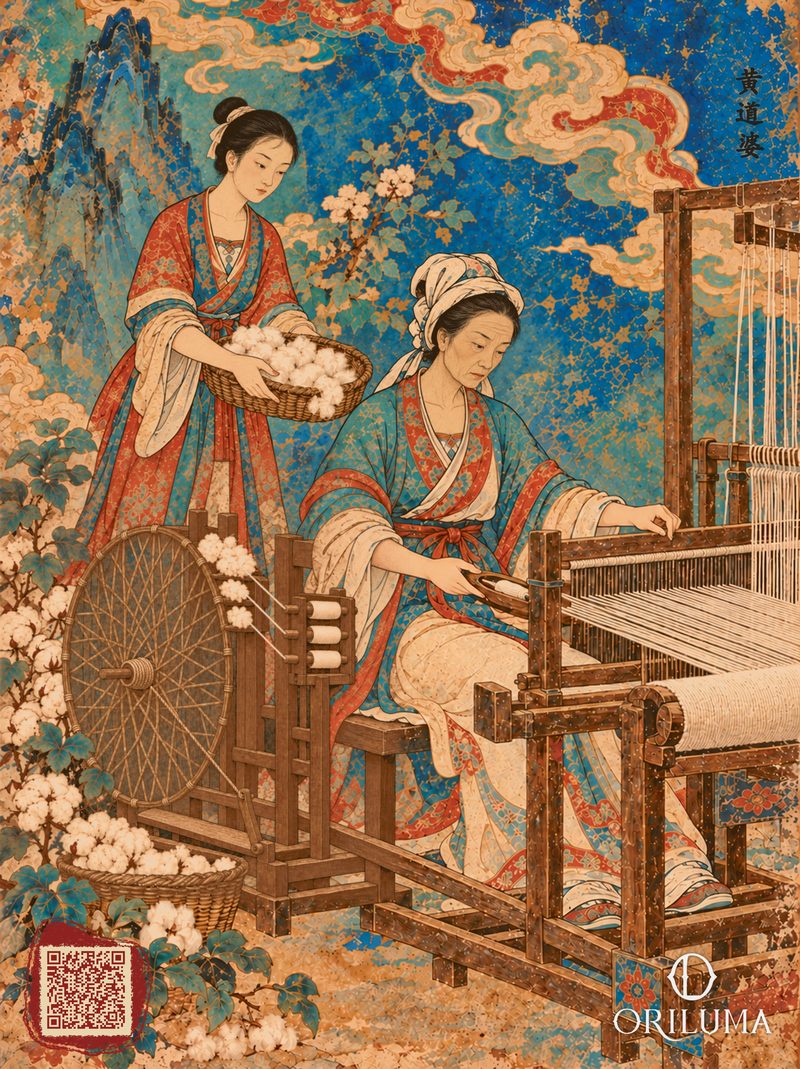
What the picture shows
Huang Daopo brought the textile skills she learned on Hainan back to Jiangnan, bringing cotton cloth into countless homes and changing many people’s livelihoods.
At the centre of the picture, a woman with a white cloth wrapped round her head sits at a wooden loom, one hand holding the shuttle, the other resting on the loom’s crossbeam, her eyes on the cloth. Beside her, in front, stands a large spinning wheel, with three spindles winding freshly spun cotton thread at once.
On the left stands another woman with a bamboo basket on her arm, full of freshly picked white cotton bolls; she looks down at the weaver. In the lower left are another basket of cotton and cotton plants hung with white bolls.
This is a picture of “the process of work”: from cotton boll to thread, and then to cloth, almost every step is shown. The figures are focused and calm, with no heroic pose at all, simply doing one thing with care. In the written records Huang Daopo was already an old woman when she returned home; the painting shows her as an old woman too, and the young woman beside her with a basket looks like a villager who has come to learn the craft from her.
The story
Huang Daopo
Huang Daopo spread cotton-textile techniques in the late Song and early Yuan. Few direct records of her early life survive. The preface to the poem “Shrine of Huang Daopo” by Wang Feng, of the late Yuan, says she came from Wujing (that is, Wunijing) in Songjiang, drifted to Yazhou when young, and only in the Yuanzhen era found a sea-going ship to bring her back. Later tradition widely holds that in Yazhou she learned from the cotton-textile traditions of the Li people the techniques of preparing cotton, spinning, weaving and dyeing.
Back in Wunijing, she taught what she had learned to the local people and improved the tools for ginning, bowing, spinning and weaving. Steps that had been laborious and slow became more efficient, and the quality of the cotton cloth also rose.
The Wunijing area gradually became known for cotton textiles, and women could add to their income through spinning and weaving. What Huang Daopo brought back was not just a particular machine, but a whole body of knowledge for turning raw material into cloth for daily use.
In the picture, cotton bolls, the spinning wheel and the loom all appear together, and the hands are at the centre of the story. Fibre goes from loose to thread, then warp and weft interlace into cloth; the figures’ patient movements link the field, the household and the market.
History and context
Origins and culture
Direct early records of Huang Daopo’s life are few. Texts such as Tao Zongyi’s Chuogeng Lu preserve the account of her teaching cotton-textile techniques. Later local gazetteers, the memory of the trade and popular worship kept adding to her image.
Tao Zongyi says only that she “came from Yazhou”; the idea that she learned from the Li comes mainly from the cotton-weaving tradition of Yazhou and from later legend. On this commonly accepted account, the technique did not spread outwards from a single centre but took shape through migration, exchange and shared labour; the knowledge of an ethnic minority made a key contribution to the development of cotton textiles in Jiangnan.
Traditional history often focuses on emperors and wars; Huang Daopo’s story shows how everyday technology changes society. Better tools, more reliable cloth and skills that could be passed on affected the clothing and lives of countless ordinary people.
So she is remembered as a pioneer of the textile industry, and she also stands for respect for the knowledge of working people. The threads in the work look slender, yet they bind together firmly the lives of different regions, different peoples and several generations.
The earliest and more reliable record of Huang Daopo is Tao Zongyi’s Nancun Chuogeng Lu (Notes Written in Nancun While Resting from the Plough), from the late Yuan. It says that early in the Yuan dynasty an old woman named Huang Daopo came from Yazhou (present-day Hainan) to Wunijing in Songjiang and taught the local people to make “tools for ginning, bowing, spinning and weaving”, and passed on weaving methods for arranging yarns and matching colours and for lifting patterns with heddles, so that the quilts, mattresses, sashes and kerchiefs of Wunijing gained vivid patterns.
The Yuan government set up “Cotton Superintendencies” (mumian tijusi) in several regions to promote the growing and processing of cotton, which shows that in this period cotton was becoming an important material for clothing and bedding. Before this, people in China mainly wore hemp and silk; the spread of cotton cloth was a change that truly affected daily life.
The traditional brocade of the Li people has also become better known as a result. In 2009, “Traditional Li textile techniques: spinning, dyeing, weaving and embroidering” was inscribed by UNESCO on the List of Intangible Cultural Heritage in Need of Urgent Safeguarding. This affirmed its historical and cultural value, and also showed that the craft is in danger of being lost.
Further reading
Sources and references
- Nancun Chuogeng Lu, juan 24Tao Zongyi · Yuan
- Wuxi Ji: “Shrine of Huang Daopo”Wang Feng · Yuan
- Yuanshi (History of Yuan): Annals of ShizuMing
More in this set