
Series · Everyday Life
The Writing Lesson
Jiào Zǐ Xí Shū · The Writing Lesson
Basis · Cultural background
What the picture shows
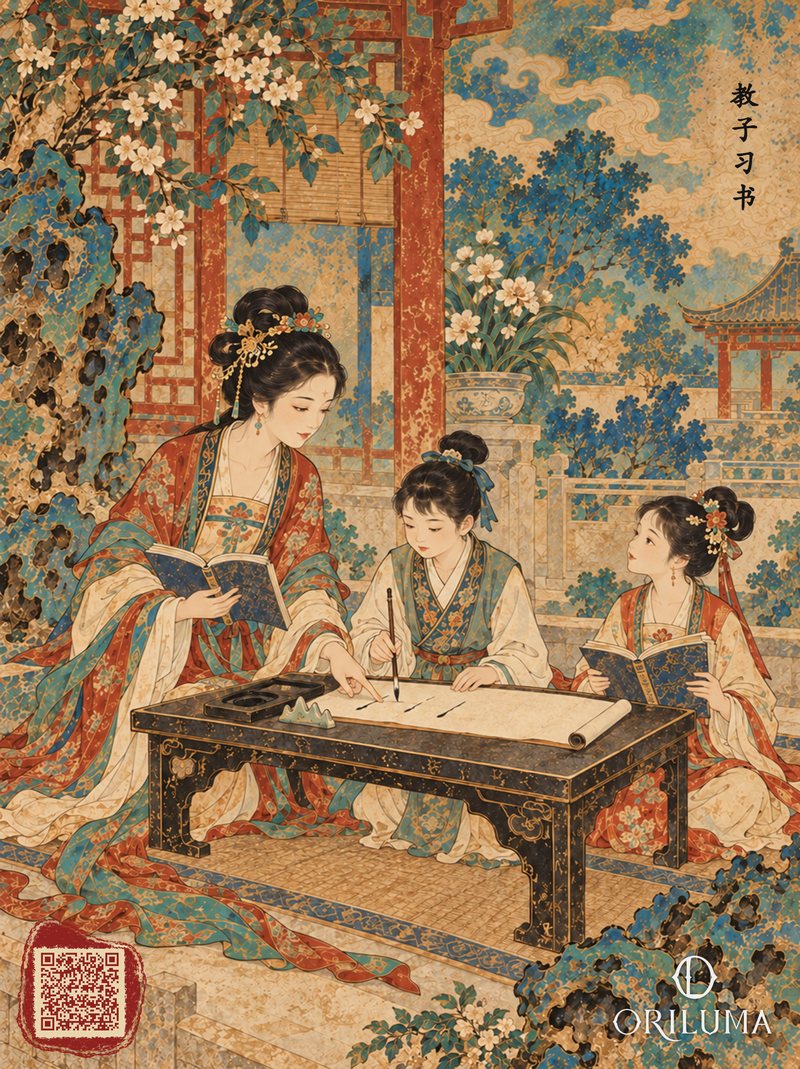
An elder bends to teach a character, a child holds the brush: through patient guidance, knowledge, manners and affection pass to the next generation.
Three people gather round a low black-lacquered table: a mother sits at the left, one hand holding a book, the other pointing at a character on the table; the child in the middle grips a brush and writes on a long scroll; the child on the right hugs a book and looks up at the mother.
On the low table stand an inkstone, a brush rest and an unrolled sheet of paper; a straw mat is spread beneath. Behind them are a red lattice window and a pavilion, and in a porcelain basin by the window white flowers are in bloom.
Each of the three looks somewhere different: the mother looks down at the characters, the child in the middle watches the tip of the brush, the child on the right looks up at the mother. By painting these small differences the picture shows teaching as more than “teaching” and “learning”: it is the way several gazes cross within one family.
The story
The Writing Lesson
“Teaching a child to write” is a subject of family education in painting, and it does not necessarily refer to Mencius’s mother, Yue Fei’s mother or any other particular person. In the picture an elder demonstrates beside the table while the child faces paper and brush: one teaches, one learns, and together they make a quiet piece of everyday life.
A beginner must first sit steadily and hold the brush, and then learn to recognise basic strokes and character structure. The elder may guide the child’s hand or point from the side; every stroke the child lays down takes observation, imitation and repeated practice.
The inkstone, ink, paper and books on the desk make the abstract word “education” concrete. Knowledge is not acquired out of nothing; it is built through small steps such as grinding ink, spreading paper, correcting and writing again.
The closer the figures sit, the more the affection in the teaching shows. Strictness is not always the same as punishment; the picture can also show a shared concentration, in which the adult slows down and the child strives to keep up.
History and context
Origins and culture
What children were taught in early education in ancient times varied according to family circumstances and historical period, and learning to read was not equally open to everyone. The elegant studies in figure paintings often stand for an idealised life, and also remind us to notice differences in educational resources.
Stories such as “Mencius’s mother moved three times”, “cutting the loom to teach her son” and “Yue Fei’s mother tattooing characters” are often counted in the tradition of “teaching sons”, but each has its own particular episode. This picture carries none of the particular marks of those tales, such as a scene of moving house, a cut piece of weaving, or characters carved on a back, so it shows an ordinary family writing lesson and does not refer to any one of them.
In Chinese culture calligraphy is at once practical writing, self-cultivation and an aesthetic pursuit. Teaching a child to write therefore includes passing on a skill, training patience and entering a cultural tradition.
The work does not record examinations or official rank but the place where learning begins. A sheet of paper, a few strokes of ink and one bending down to guide are enough to let the experience of one generation travel along the wrist to the next.
Early education in ancient times was not only about learning characters but also about manners and conduct. Primers such as the Three Character Classic, the Thousand Character Classic and the Hundred Family Surnames spread widely because they all suited being recited aloud by an elder at home, with the child following along.
“Mencius’s mother moved three times” and “cutting the loom to teach her son” come from the Biographies of Exemplary Women, while the tale of Yue Fei’s mother tattooing characters spread after the Song dynasty. All of them treat “teaching a son” as a mother’s most important duty, but this picture chose a more everyday kind: not a stern lecture but a writing practice shared side by side.
The tradition of “teaching a child” has other voices too. The stories of Mencius’s mother and Yue Fei’s mother were long taken as models of a mother’s teaching, but today some point out that the children who could be educated in ancient times were largely limited to scholarly and affluent families, and that such subjects often show an idealised family.
Further reading
Sources and references
- Biographies of Exemplary Women, “Maternal Models” (Lienü Zhuan, Muyi Zhuan)Liu Xiang · Western Han
- Three Character Classic (Sanzijing)traditionally attributed to Wang Yinglin · Song