
Series · Bonds of Love
Lady Meng
Mèng Cáirén · Lady Meng
Basis · Directly based on source material
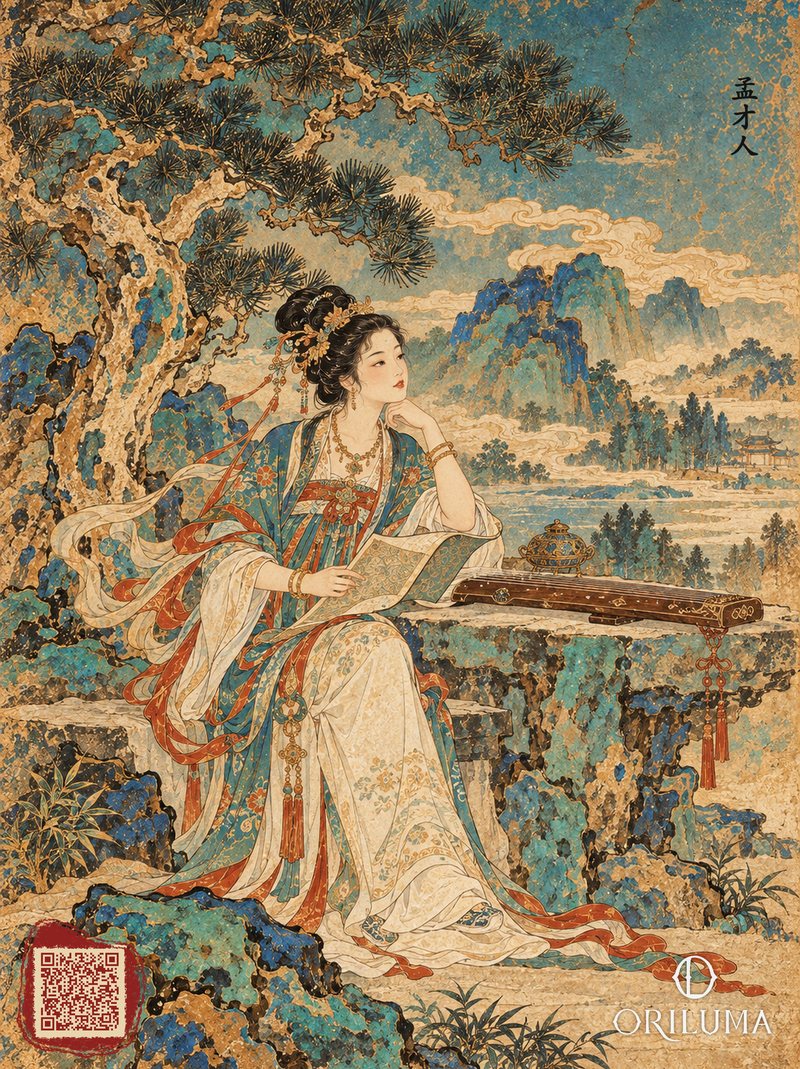
What the picture shows
One song, “He Manzi”, leaves a palace lady’s grief in its last note, and loyalty and legend overlap.
Lady Meng sits on a rock beneath an old pine, one hand at her cheek, the other holding a sheet of paper, her gaze fixed on nothing. On the stone ledge beside her lies a zither, with a small incense burner next to it; farther off are a river and pale green hills.
A pine branch bends low from the upper left, old and strong, a contrast to her youth. Her dress is white and blue-green, almost the colour of the rocks; only the red ribbon at her chest is bright.
There is no stage and no audience. The painter has moved the “last song” of the tale to a quieter place: the singer sits alone, and the song has not yet begun, or has just ended.
The story
Lady Meng
When Emperor Wuzong of Tang fell gravely ill, Lady Meng, a palace lady of the rank of cairen, attended him. Tradition says that, knowing he would not recover, the emperor asked how she would live afterwards; she answered that she would follow him in death, and asked to sing one last song at his bedside.
The song she sang was “He Manzi”. When it ended she collapsed in grief and died before the emperor. Later retellings often use the words “heart-broken” for this moment, as if a sorrow too great for speech had been condensed into a song.
In the picture Lady Meng sits under a pine, a sheet of paper in her hand and a zither beside her. What the viewer meets is not a lively banquet but a private farewell. The stillness of the figure against the imagined melody makes the ending weigh more heavily.
“He Manzi” was originally a popular tune of the Tang dynasty, and many poets took it as a subject. Lady Meng’s story tied the tune to the fate of palace women, turning the music from entertainment into memory and mourning.
History and context
Origins and culture
The records of this event do not agree. The preface to Zhang Hu’s “Lament for Lady Meng” and Kang Pian’s Ju Tan Lu say that Lady Meng sang “He Manzi” at Wuzong’s bedside and died as the song ended; the Tang histories record instead that Wuzong’s Lady Wang (later honoured posthumously as a Virtuous Consort) followed him in death. Each account has its own source, and later readers differ on how the two relate.
So Lady Meng cannot simply be treated as a biography whose details are all settled. She is more like a figure shaped together by palace memory, a legend about a tune, and ideas of loyalty, in which names and deeds overlapped as the story was handed down.
Older tellings often praised “dying for one’s lord”. Today we can also see a more complicated side: the lives and standing of palace women depended on imperial power, and her choice was both celebrated and a sign of how narrow a space the system left to an individual.
The value of keeping this work lies not in asking viewers to repeat the old verdict but in letting that one song be heard again. Her figure reminds us that behind the grand history of the court there are individuals who left their trace in song.
“He Manzi” was first the name of a song. Bai Juyi writes in his poem that people say “Manzi” was a person’s name, and that the tune was composed when he was about to be executed; the poem’s last line says the tune is “broken-hearted sound from the very first note”. Ever since, the tune has carried a colour of sorrow.
The Tang poet Zhang Hu wrote “Lament for Lady Meng”, which says, in effect, that because of a single “He Manzi” one must mourn Lady Meng at the Yellow Springs. The poem shows that her story was already in circulation in the late Tang and was closely bound to this tune.
Emperor Wuzong reigned from 840 to 846 and in his later years favoured Daoism; around 845 he began the Huichang persecution of Buddhism. Placing Lady Meng’s story in the emperor’s last years sets one palace lady’s private grief beside a turning point of a dynasty.
Further reading
Sources and references
- “Lament for Lady Meng” (Meng Cairen Tan)Zhang Hu · Tang
- Ju Tan Lu (Record of Lively Talk)Kang Pian · Tang
- “He Manzi”Bai Juyi · Tang